New Month. New History, this month Maps “Airfields and their support buildings”
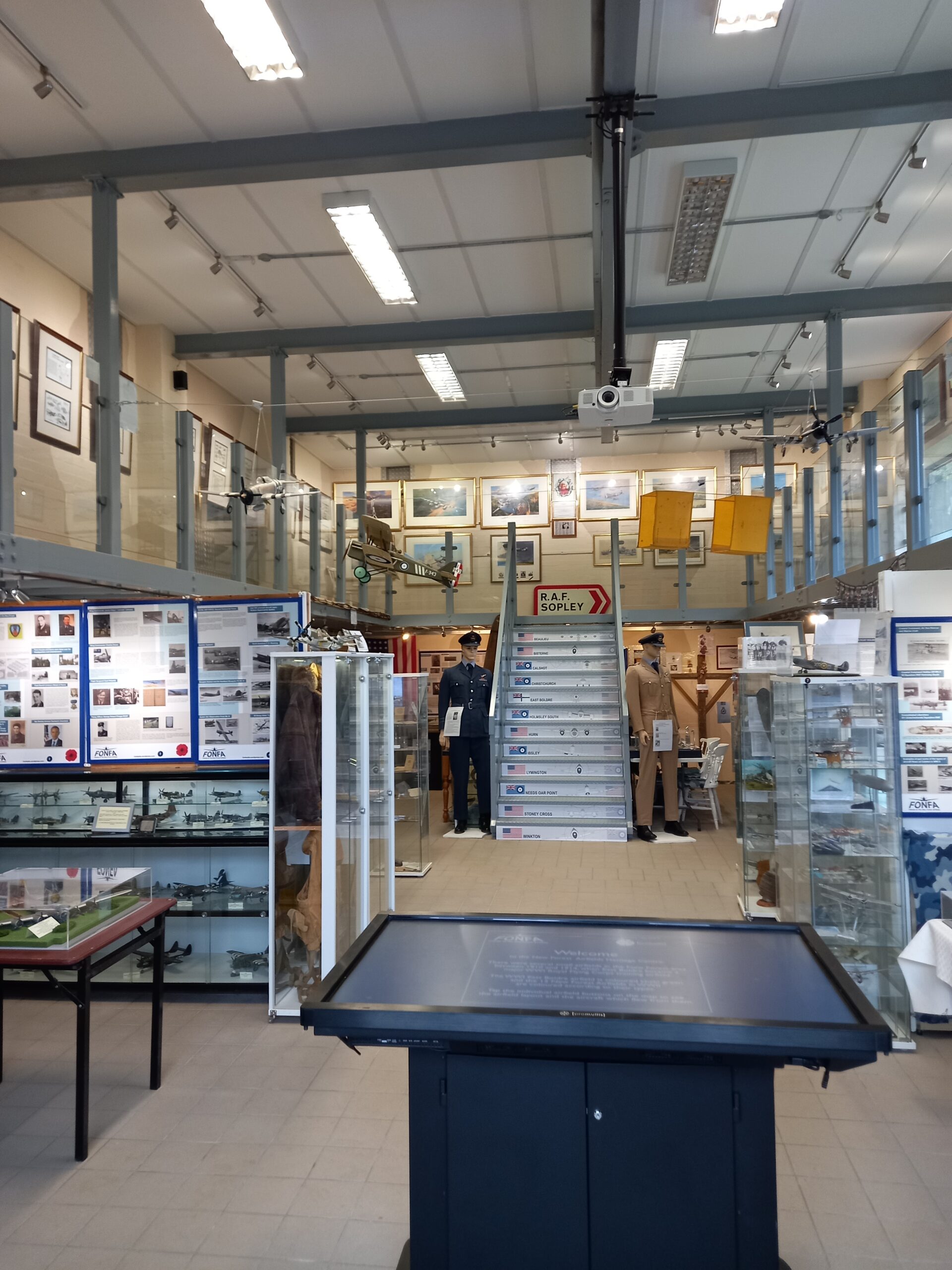
As well as our normal information boards , models, photographs, equipment, videos and CGI we have a display just for the month of July. Entitled The 12 Airfields of the New Forest
This will consist of declassified maps of the airfields showing their layout and maps of the camps which were required to support them.
These include Beaulieu, Calshot ,Hurn(Now Bournemouth International Airport, Holmsley South, Stoney Cross and Ibsley as main airfields.
Bisterne, Winkton, Lymington and Needs Oar Point. The temporary ones April to July 1944 called Advanced Landing Grounds (ALG) were large.
These maps give an idea of the sheer size of the airfields and the accompanying personnel camps in the New Forest.
For example, in the now empty green fields near the coast between Bucklers Hard and the Lymington ferry was the:
Lymington (ALG) hosting the 50th Fighter Group of the US Army Air Forces, which consisted of 3 fighter squadrons equipped with approximately 75 to 90 Republic P-47 Thunderbolt aircraft. To support these aircraft the base had an estimated total of 1,000 to 1,200 personnel.
A Thunderbolt when fully loaded could weigh up to 8 tons. It measured 36 ft 2 in (11.02 m) in length, 14 ft 8 in (4.47 m) in height, and had a wingspan of 40 ft 9 in (12.42 m).
For comparison a standard double-decker bus generally measures approximately 10 to 12 metres (33 to 39 feet) in length, 2.55 metres (8 feet 4 inches) in width, and 4.4 metres (14 feet 5 inches) in height.
Also, at Needs Oar Point (ALG) in 1944, No. 146 Wing (RAF) operated with five full squadrons of Hawker Typhoon fighter-bombers. With an average establishment of roughly 20 aircraft per squadron, the wing typically fielded about 100 operational Typhoons at any given time.
An RAF Typhoon squadron required roughly 150 to 200 groundcrew. Across the wing’s four to five squadrons, this meant an estimated total of 600 to 1,000 ground personnel .
Operating from April to July 1944 in the buildup to D-Day, it was one of the busiest temporary airfields in the UK.
The Typhoon had a Length of 31 ft 11.5 in (9.741 m) a wingspan off 41 ft 7 in (12.67 m) a height of 15 ft 4 in (4.67 m). Its maximum takeoff weight was 13,250 lb (6,010 kg) with two 1,000 lb (450 kg) bombs.
We look forward to seeing you.