Czech Armed Forces Day Ceremony 16th June 2026
“What a wonderful evening. Four of us (Sam and Corrina Ruddy, Richard Grycz and myself) were invited to the Embassy of the Czech Republic to take part in their Armed Forces Day celebration. It was a great honour to represent FONFA at this event and we look forward to welcoming them back to our annual Memorial Service in September again.” Dave Connor 16-06-26
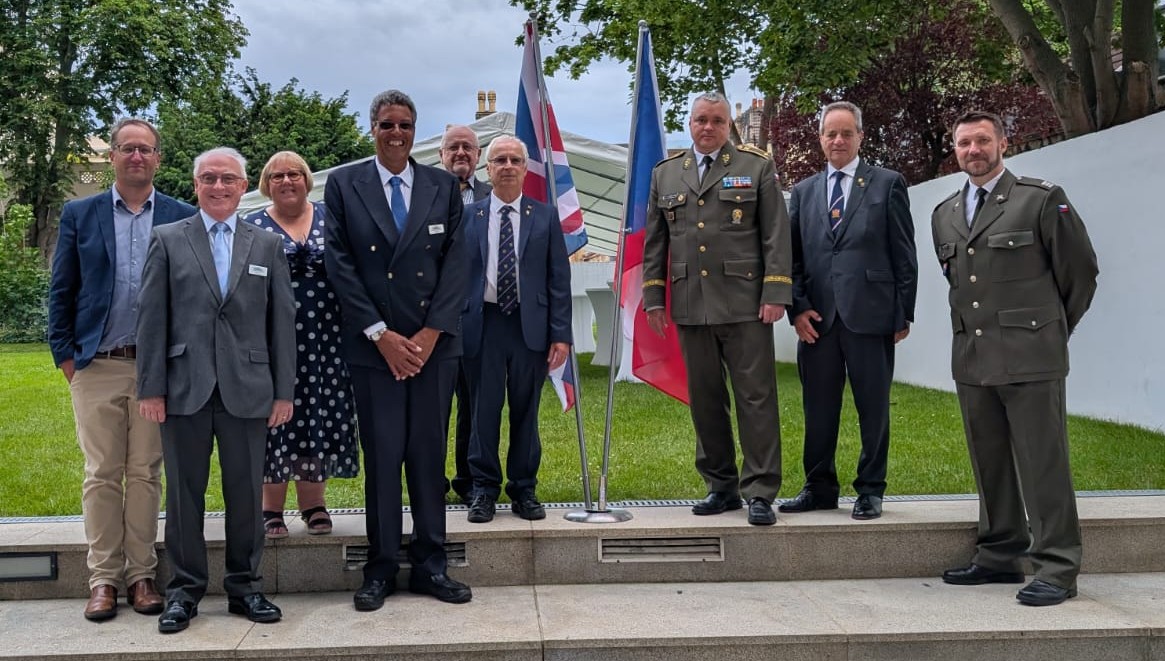
The photo below shows Richard,Dave,Corrina and Sam with the Czech Defence attach(near Czech Flag) Brigadier General Miroslav Heger. Next to the Brigadier is FONFA life member John Polak treasurer Memorial Association for Free Czechoslovak Veterans. John Polak’s involvement with the MAFCSV is deeply personal. His father, Colonel Arnost Polak, was a wireless operator and gunner in the renowned No. 311 (Czechoslovak) Squadron of the RAF.
“The MAFCSV is a not-for-profit organisation. Its purpose is to honour and remember the Czechoslovak servicemen and women and others who fought for the freedom and democracy of Czechoslovakia and Europe during WWII and subsequently, and to ensure that they are never forgotten and that their story lives on for future generations. It is recognised by both the Czech and Slovak Embassies in the UK and by their governments as the leading organisation with this role in the UK.” Information from MAFCVS
“ Following the invasion of Czechoslovakia by Nazi Germany in March 1939, Czechoslovaks escaped through Europe to French held territory to fight with the Western Allies in the Battle of France in 1940, initially under the French Foreign Legion and then as the 1st Czechoslovak Division.
As the Allies retreated, the Czechoslovaks withdrew from the Marne to various ports in the south of France from where they were evacuated to the UK in an operation organised by the Royal Navy using commandeered merchant ships.
On arrival, they numbered some three thousand five hundred soldiers and airmen, the majority initially based in a camp in the grounds of Cholmondeley Castle in Cheshire. Determined to continue the fight, they reorganised quickly and formed a brigade and three Czechoslovak RAF Squadrons. In time, the overall Czechoslovak military infrastructure consisted of a Ministry of Defence, the brigade, four RAF squadrons and training and administrative units. Czechoslovak men and women also served in various other military units, in particular in British ones.
Britain was short of trained aircrew and the Czechoslovak airmen were a valuable addition to the RAF’s fighting strength. They were soon in action with two RAF (Czechoslovak) Squadrons, Nos. 310 and 312, taking part in the Battle of Britain. A third squadron, No. 311, which also formed in 1940, was a bomber squadron; it later transferred from Bomber Command to Coastal Command to fly maritime patrols(from Beaulieu Airfield). A fourth squadron, No. 313, another fighter squadron, was formed in January 1941. (These fighter squadrons flew from Ibsley Airfield for a time)
All four squadrons played an active role throughout the War.
A number of Czechoslovaks served in other squadrons, in particular in No. 68 Squadron, a night fighter squadron.” Information from MAFCVS.